
Morocco is a country of contrasts. In a single trip you can bargain in a medina market in the morning, walk a mountain trail in the afternoon and spend the next night in a desert camp. We live and work in Imlil, in the High Atlas, and these are the ten places we would point any first-time visitor toward. We have ordered them roughly as a route, starting in Marrakech, crossing the mountains to the desert and finishing on the coast.
A quick way to think about the country:
- Old cities: walled medinas full of workshops, markets and family homes.
- Mountains: the Atlas ranges, with walking trails and Berber villages.
- Desert: the great dune fields of the Sahara.
- Coast: beaches and old ports on the Atlantic and the Mediterranean.
1. Marrakech
The Red City has an energy no other Moroccan city quite matches. Most visits start in Djemaa el Fna, the big square at the edge of the medina, which changes character through the day. Mornings bring performers and street entertainers, the afternoon belongs to musicians and storytellers, and in the evening rows of food stalls turn the whole space into an outdoor dining room.
What to see
- The Koutoubia Mosque: its tall minaret is the landmark you will use to find your way.
- Bahia Palace: painted ceilings, carved wood and quiet courtyards from the city's royal past.
- The souks: lanes of spices, carpets, leather and metalwork, with craftsmen working in small shops as you pass.
- Madrasas: old religious schools known for their fine tilework and carved plaster.
- Riads: traditional courtyard houses, many now run as small guesthouses.
- Gardens: a famous botanical garden with cobalt blue buildings and a small museum of Berber objects sits just outside the old town.
For a change of pace, the newer Gueliz district has contemporary galleries showing Moroccan and international artists, and restaurants that mix local flavours with other cuisines.
2. Imlil and the Toubkal valleys
Imlil is our home. The village sits at around 1,800 m in the High Atlas and is the usual starting point for climbing Toubkal, at 4,167 m the highest mountain in North Africa. You can trek here in every season, though the conditions change a lot between summer and winter.
The valleys around the village are a patchwork of terraced fields, old walnut trees, clear streams and stone and earth houses. Local families run simple guesthouses (gîtes), and well-used trails suit every level, from a gentle half-day walk to a multi-day circuit. A local guide will also take you to more remote villages, where daily Berber life carries on much as it always has.
3. Aït Ben Haddou
This is the best known ksar, or fortified village, in the country, and a UNESCO World Heritage site. Its houses are built from pisé, rammed earth, decorated with geometric patterns and stacked up the side of a hill. Climb to the old granary at the top for a wide view toward the Atlas. The village has been used as a film set many times, and local families still keep the old building methods alive.
4. Todra Gorge
In the east, the Todra river has cut a narrow canyon through the mountains, with red limestone walls rising up to around 300 m. Palm groves and small oases fill the valley floor, clear streams run through the gorge, and Berber villages cling to the slopes above. It is also a well-known spot for rock climbing. Because it lies on the road to the desert, many trips to the Sahara stop here for a walk.
Look out for the contrast of green fields against the rust-coloured rock, and for shepherds moving their flocks along paths that have been used for generations.
5. Merzouga and the Sahara
Near Merzouga, the dunes of Erg Chebbi rise up to about 150 m, one of the two great Saharan ergs, or sand seas, in Morocco. A typical stay includes:
- a camel trek across the dunes
- a night in a Berber camp
- sandboarding on the steeper slopes early in the morning
- music and drumming around the fire after dinner
The night sky is the real highlight. With no city light around, the Milky Way is easy to see, and guides often share stories and songs over mint tea. Days can be very hot and nights cold, so pack layers. Many people add a stop at a nearby oasis, where green fields appear right at the edge of the sand.
6. Fez
The old medina of Fez, Fez el Bali, dates from the 9th century and is a UNESCO World Heritage site. Its lanes are far too narrow for cars, so donkeys and handcarts still carry goods through the town. It feels less like a museum than a working city that never stopped.
- The tanneries: leather is still dyed in open stone vats using very old methods.
- Al Quaraouiyine: often described as the oldest existing university in the world.
- Craft quarters: coppersmiths, weavers at their looms and potters making the blue Fassi ceramics the city is known for.
- Souk el Attarine: cones of spices, regional carpets, traditional remedies and natural beauty products.
Many workshops are family businesses where skills pass from one generation to the next, which is why Fez is often called the craft capital of Morocco.
7. Chefchaouen
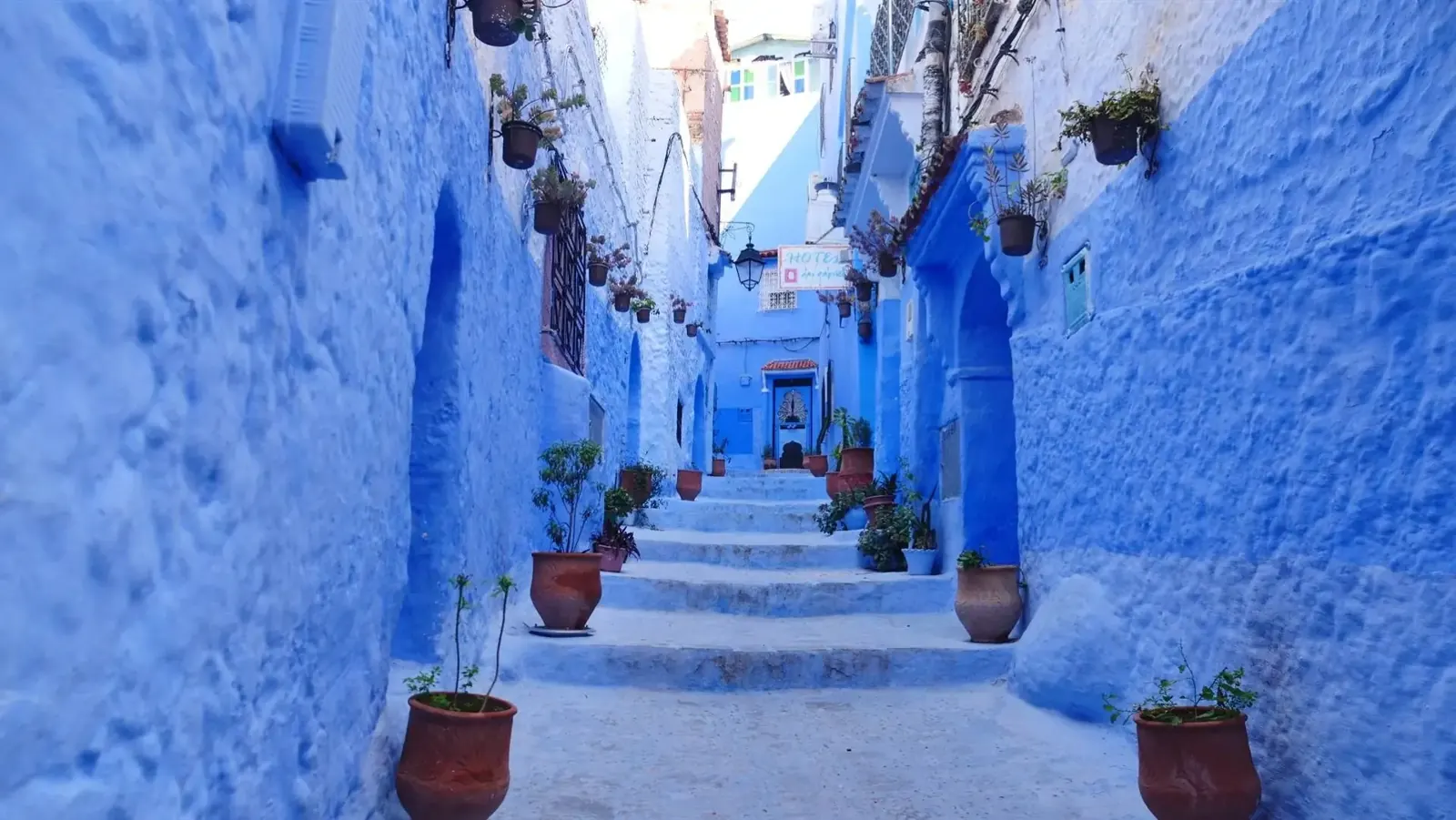
High in the Rif Mountains, Chefchaouen is famous for streets washed in every shade of blue. There are several stories about where the tradition comes from; one popular account links it to Jewish families who settled in the town. Whatever the origin, residents keep repainting, and the result is one of the most photographed towns in the country.
The main square, Plaza Uta el-Hammam, is lined with cafés and overlooked by the red walls of the old kasbah. In the hills around town you can walk to:
- Talassemtane National Park, home to the rare Barbary macaque
- God's Bridge, a natural rock arch with wide views
- the Akchour waterfalls, with clear pools for a swim
8. Tangier
At the northern tip of Africa, Tangier looks across the water to Europe, and you can feel both influences in its streets. White houses climb the hills above the sea. In the old kasbah, a former sultan's palace now holds the Kasbah Museum, with Moroccan art, costumes and manuscripts from many centuries.
About 14 km from the centre are the Caves of Hercules, where the sea breaks through an opening often said to look like a map of Africa. Back in the medina, spend time in the old tea houses and cafés once loved by writers and artists, small galleries and markets selling leather and textiles.
9. Rabat
The capital is calmer than Marrakech or Fez and easy to explore on its tram network. Start with the 12th-century Hassan Tower and the Mausoleum of Mohammed V beside it, a fine example of modern Moroccan craftsmanship. Then walk through the white and blue lanes of the Kasbah of the Oudayas, rest in the Andalusian Gardens and see a show at the Mohammed VI Museum of Modern Art. Festivals, exhibitions and concerts take place through the year.
10. Essaouira
On the Atlantic coast, Essaouira mixes art, history and the sea. Its walled medina, a UNESCO World Heritage site, has 18th-century fortifications, white and blue houses and many small woodwork shops and galleries. Each morning the blue fishing boats come back into the port with the catch, and the harbour is the liveliest place in town.
Strong trade winds, called the alizé, make Essaouira a favourite for wind sports:
- Kitesurfing at Essaouira beach and nearby Sidi Kaouki
- Windsurfing all year, for beginners and experts alike
- Surfing, with the best waves from October to April
If you would rather do nothing, the long beach and its cafés are perfect for a slow afternoon with mint tea.
Practical tips for travelling in Morocco
When to go
- Spring (March to May) and autumn (September to November) bring the most comfortable temperatures in most regions.
- The dates of Ramadan move every year. Travelling during it is possible and can be a special experience, but check the dates when you plan.
- Local festivals are worth timing a trip around if you enjoy music and culture.
Getting around
- Trains link the main cities; first class is worth the small extra cost.
- National coach companies run reliable routes between cities.
- In town, use the small red petit taxis and ask for the meter.
- For mountain and desert areas, a private driver arranged through a trusted local guide is often the easiest choice.
Safety and local customs
- Dress modestly, with shoulders and knees covered.
- Bargaining is normal in markets; many people open at around a third of the first price.
- Watch for common tricks: so-called free guides who ask for money later, people who tell you a sight is closed so they can take you elsewhere, and taxis that will not use the meter.
Health and comfort
- Drink bottled water.
- Carry cash, as many places do not take cards.
- Learn a few words of Arabic or Tamazight.
- Download offline maps before you go.
- Get travel insurance that covers trekking and desert activities.
Quieter places to add
If you have more time, these smaller places are worth a look:
- Taghazout: a relaxed surf village north of Agadir.
- Oualidia: a calm lagoon known for its oyster farms.
- Midelt: a gateway to the Middle Atlas, surrounded by apple orchards.
- Sidi Ifni: art deco buildings above wide, empty beaches.
More and more visitors also choose homestays and artisan cooperatives, which keep the money from tourism in local hands. In the mountains around Imlil, staying with a family and walking with a guide from the valley is one of the simplest ways to do that.
Frequently asked questions
Which places should I see on a first trip to Morocco?
Our list covers Marrakech, Imlil and the Toubkal valleys, Aït Ben Haddou, Todra Gorge, Merzouga and the Sahara, Fez, Chefchaouen, Tangier, Rabat and Essaouira. With limited time, pair one or two cities with either the mountains or the desert rather than trying to see everything.
Why do so many trips start in Marrakech?
It has the busiest airport for many international routes, it is full of things to see, and it sits close to the High Atlas. You can be walking in the mountains a short drive after leaving the medina.
What makes Chefchaouen special?
The blue-painted streets are the obvious draw, but the hiking in the surrounding Rif Mountains, from national park trails to waterfalls, is a good reason to stay more than one night.
What can I do in Essaouira?
Walk the medina walls and the fishing port, visit the galleries and woodwork shops, and try kitesurfing, windsurfing or surfing on the windy beaches.
What should I know before going to Merzouga?
Expect camel rides across the dunes, a night in a desert camp and some of the clearest night skies you will ever see. Bring warm layers for the evening, as temperatures drop fast after sunset.
Any general tips for a first visit?
Aim for spring or autumn, check the Ramadan dates, use trains and coaches between cities and metered taxis within them, dress modestly and keep an eye out for the usual tourist tricks. For trekking, travel with a licensed local guide.